%20(2).png)
Space Wrench: From Digital File to Orbit
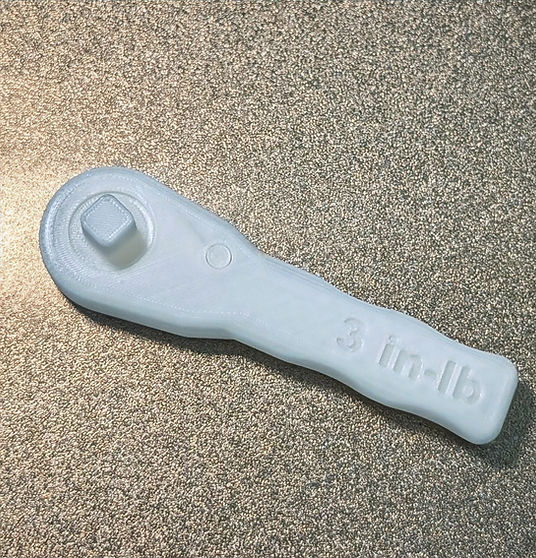
Imagine you are hundreds of miles above Earth, orbiting the planet at more than 17,000 miles per hour, and you suddenly realize you need a tool you do not have. On Earth, that might mean a quick trip to a hardware store. On the International Space Station, it used to mean waiting months for a resupply rocket, if a replacement was even available at all. Then, in December 2014, that problem changed forever. NASA and a company called Made in Space did something that sounds like science fiction. They emailed a tool into space, and a 3D printer on board the station built it in real life.
The tool was a simple ratcheting socket wrench. But the way it got there made history.
A Wrench With No Physical Delivery
The story starts with a coincidence. Engineers at Made in Space, the Silicon Valley company that built and operated the station's 3D printer, overheard that ISS Commander Barry "Butch" Wilmore needed a ratcheting socket wrench. Normally, getting a specific tool like that to the space station would require planning a supply mission, a process that could take months and cost a serious amount of money, since every pound of cargo launched into orbit is expensive.
Instead of waiting for a rocket, the Made in Space team saw an opportunity. Engineer Noah Paul-Gin designed a digital 3D model of a ratcheting wrench, built specifically to work as a single print with all of its moving parts included, and without needing extra support material that would normally have to be removed afterward. That was a tricky design challenge on its own, since a functioning ratchet mechanism has interlocking parts that all had to move freely right out of the printer.
Once the design was ready, Made in Space sent the file to NASA for a safety check. Then came the historic moment. NASA transmitted the wrench's digital blueprint, called a CAD file, up to a laptop connected to the 3D printer aboard the station. In other words, instead of shipping a physical object into space, they sent information. About four hours later, the printer had turned that information into a real, physical tool, entirely on orbit.
Why This Was Such a Big Deal
This was not the first object ever 3D printed in space. Earlier that same year, the printer had already produced test pieces and even a spare part for itself. But the wrench was different. It was the first time an object had been designed on Earth, transmitted digitally to space, and manufactured there specifically to be a working, functional tool. NASA called it an uplink tool, meaning it was built entirely from data sent up to the station rather than being preloaded before launch.
Niki Werkheiser, who managed the 3D printer program for NASA, described why this mattered so much. According to Werkheiser, being able to transmit a file to the station as quickly as sending an email opens up possibilities ranging from building small satellite components to experiment hardware, even objects that could not have been launched into space in the first place.
That last idea is worth pausing on. Some shapes and structures sag or deform under Earth's gravity during manufacturing, so they can only be built successfully in microgravity. Being able to both design and manufacture something entirely off the planet suddenly made a whole new category of objects possible.
How Does a 3D Printer Even Work in Zero Gravity?
Printing in space is a lot harder than it sounds. The printer used on the station, built by Made in Space, worked using a process called fused filament fabrication. A spool of plastic filament, in this case a durable material called ABS, was fed through a heated nozzle and extruded in thin layers, one on top of another, gradually building up a three-dimensional shape.
Here on Earth, gravity helps pull melted plastic downward and keeps each layer settled in place as a printer works. In microgravity, that helpful pull disappears entirely. Engineers had to redesign nearly everything about how the printer functioned, since layers only a fraction of a micron out of alignment could throw off an entire print. The printer also had to be built to safely contain and manage heat without relying on the natural air convection that helps regulate temperature in a printer on the ground.
The station's printer lived inside something called the Microgravity Science Glovebox, a sealed, controlled workspace inside the space station's Destiny laboratory module, which kept both the crew and the surrounding cabin safe from any loose particles or fumes during printing.
What Happened to the Wrench?
Interestingly, the wrench itself was never actually used by the crew. It had been designed primarily as a test of the uplink process itself, proving that a tool could be designed, transmitted, and manufactured entirely through digital means. Because of that, the ratchet was eventually sent back down to Earth so engineers could closely examine it and compare its performance to an identical wrench printed under normal gravity conditions back on the ground.
In a nice bonus for space fans and makers everywhere, NASA released the wrench's digital design file publicly just about a week later, meaning anyone on Earth with access to a 3D printer could download and print their own copy of the same tool that had been manufactured in orbit.
Why This Still Matters Today
This experiment was about far more than one convenient tool. It was a real demonstration of a concept NASA has been chasing for decades: the idea of manufacturing what you need, exactly when and where you need it, instead of hauling every possible spare part along for the ride.
This capability becomes even more critical the farther astronauts travel from Earth. On a mission to the moon or eventually to Mars, waiting months for a resupply rocket will not be an option, and depending on how far away the destination is, it might not be possible at all. A joint study between Made in Space and NASA estimated that roughly 30 percent of broken parts aboard the space station could potentially be repaired using 3D-printed replacements, a number that hints at how valuable on-demand manufacturing could become for future long-duration missions.
Since that first wrench, in-space manufacturing has continued to advance. In 2023, the European Space Agency sent a printer to the station capable of working with metal instead of plastic, using a method called directed energy deposition to melt metal wire into structural parts, opening the door to manufacturing tools and components sturdy enough for more demanding jobs.
The Bigger Picture
What happened in December 2014 was a small, simple object with an outsized meaning. A wrench that never even got used by an astronaut became one of the clearest proofs yet that the future of space exploration might not depend only on how much cargo a rocket can carry. It might also depend on how well astronauts can build exactly what they need, right where they are, using nothing more than a digital file and a printer millions of miles from the nearest hardware store.
Sources
Pearlman, Robert Z. "How to 3D Print a Space Station Wrench Emailed to Orbit." Space.com, December 30, 2014. https://www.space.com/28118-3d-printed-wrench-space-station.html
Spaceflight Now. "Ratchet wrench 'emailed' to space station." December 22, 2014. https://spaceflightnow.com/2014/12/22/ratchet-wrench-emailed-to-space-station/
Hessman, Travis M. "NASA Just Emailed a Wrench to Space." IndustryWeek, December 22, 2014. https://www.industryweek.com/technology-and-iiot/article/21964281/nasa-just-emailed-a-wrench-to-space
CNN Business. "Twist and shout: NASA prints 3-D wrench in space." December 19, 2014. https://www.cnn.com/2014/12/19/tech/feat-3d-wrench-nasa/index.html
NASA. "Space Station 3-D Printer Builds Ratchet Wrench To Complete First Phase Of Operations." https://www.nasa.gov/missions/station/space-station-3-d-printer-builds-ratchet-wrench-to-complete-first-phase-of-operations/
Spaceflight Now. "3D printer activated aboard the International Space Station." November 18, 2014. https://spaceflightnow.com/2014/11/18/3d-printer-activated-aboard-the-international-space-station/
AZoM. "Made In Space: Zero-Gravity 3D Printing." https://www.azom.com/article.aspx?ArticleID=12187
NASA Technical Reports Server. "3D Printing in Zero G Technology Demonstration Mission: Summary of On-Orbit Operations, Material Testing, and Future Work." https://ntrs.nasa.gov/citations/20160013379


Comments