%20(2).png)
Silica Gel Packets: Invisible Protection Everywhere
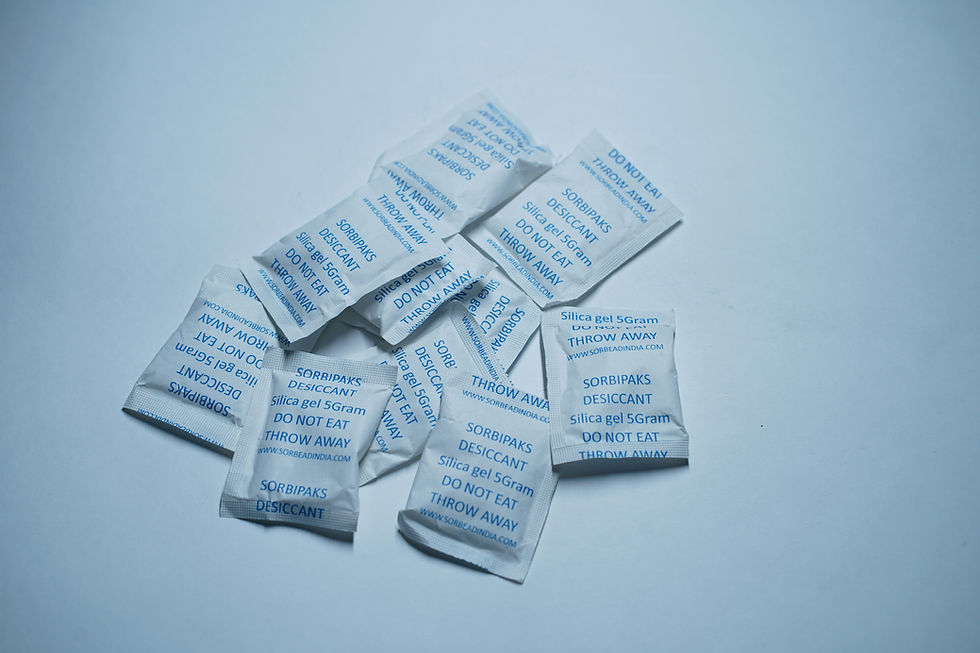
You receive a package. You open it and immediately encounter small white or translucent packets. The label warns: DO NOT EAT. You remove them and throw them away without a second thought. You might do this dozens of times per year without understanding what you just discarded. These packets contain silica gel, one of the most useful and ubiquitous materials in modern commerce. They appear in shoes, electronics, supplements, spices, beef jerky, camera housings, and thousands of other products. They exist to protect what you care about from something you rarely think about: moisture.
Most people know silica gel packets exist and know they are somehow related to keeping things dry. But few understand what they actually are, how they actually work, or why they are actually important. Understanding these packets requires understanding a specific chemistry process that most people have never heard of, but that occurs billions of times per day in small packets around the world. The packets themselves seem simple. Yet they represent a remarkable engineering solution to a problem that has plagued commerce for millennia: how to keep goods dry during storage and transport.
What Silica Gel Is: Silicon Dioxide in a Special Form
Silica gel is not actually a gel. This is the first misconception to clear away. The name is misleading. Silica gel is a granular, porous solid made of silicon dioxide. Silicon dioxide is SiO2, the same compound found in sand, quartz, and glass. When you hold a silica gel bead between your fingers, it feels hard, not gel-like. The beads are translucent or white and typically a few millimeters in diameter. They feel brittle and dry. They do not feel like anything that would absorb water. Yet they absorb water exceptionally well.
Understanding how requires understanding the structure of the beads. Unlike solid glass or quartz, silica gel beads are extremely porous. The beads contain millions of microscopic pores, each too small to see without a microscope or electron microscope. These pores are not randomly distributed. They form a regular, interconnected network throughout the bead structure. The pore network gives silica gel an extraordinarily high surface area relative to its volume. A single gram of silica gel has a surface area of approximately 2,500 square feet. This is equivalent to saying that the surface area of a single bead smaller than a grain of rice is larger than a basketball court.
This massive internal surface area is the key to understanding how silica gel works.
How Silica Gel Works: Adsorption, Not Absorption
When you place a silica gel packet in a humid environment, it draws moisture from the air. Most people describe this as the packet "absorbing" water, similar to how a sponge absorbs water by pulling liquid into its bulk material. This description is imprecise. Silica gel does not absorb water in the way a sponge does. Instead, it adsorbs water. The difference is crucial.
Adsorption is a surface phenomenon. Water molecules in the air collide with the surface of the silica gel beads. When a water molecule contacts the porous surface, it adheres to that surface through weak intermolecular forces. The water molecule sticks to the surface of the silica rather than soaking into the bulk material. The distinction matters because it explains why silica gel can be reused. If water soaked into the bulk material, it would require dissolving into the structure, and removing it would be difficult or destructive. But if water merely adheres to the surface, applying heat can cause the water molecules to vibrate with sufficient energy to break free from the surface and escape as vapor.
The process of water molecules adhering to the surface is called adsorption. Water molecules drift into the pores of the silica gel beads. They encounter the silica surface, and the attractive forces between water molecules and the silica surface cause them to stick. Layer after layer of water molecules accumulates on the surfaces, creating a thin film of water throughout the pore network.
This continues until either the silica gel reaches its maximum capacity (typically 35 to 40 percent of its own weight in moisture) or the surrounding air reaches equilibrium with the moisture level of the silica gel. At that point, no more water can be adsorbed because the driving force disappears.
Different Types: Indicating and Non-Indicating
Not all silica gel packets are identical. Two main types exist: indicating and non-indicating.
Non-indicating silica gel is white or translucent and does not change color as it absorbs moisture. This is the most common type found in food packages, electronics, and general commercial applications. Non-indicating gel is preferred when the consumer should not see evidence of moisture absorption or when the package needs to maintain a clean, professional appearance.
Indicating silica gel contains a color-changing indicator chemical. The most traditional indicator is cobalt chloride, which is blue when dry and changes to pink when saturated with moisture. As the beads absorb water, they gradually shift from blue to pink, providing a visible signal that the beads have reached saturation.
Safer alternatives to cobalt chloride exist. Some manufacturers use other indicators that change from orange to green or from orange to colorless. These alternatives avoid cobalt, which is considered a health concern if ingested in large quantities.
Indicating gel is useful in applications where you need to know when the desiccant has reached saturation without opening the package to inspect the beads. Gun safes, camera housings, and collectors' storage containers often use indicating gel so the owner can see at a glance whether regeneration is needed.
Why They're Important: The Consequences of Moisture
Understanding why silica gel packets exist requires understanding what moisture does to the things you want to protect. Food can become stale, develop mold, or lose nutritional value when exposed to moisture. Vitamins and supplements can degrade when moisture causes the active ingredients to react with water. Medications can lose potency or become unsafe. Spices can clump or lose flavor. Electronics can develop corrosion, short circuits, or condensation inside components. Photographs and documents can develop mold spots or deteriorate. Leather can crack or develop mildew. Metal tools can rust. Collectibles can be damaged.
Moisture is perhaps the most common and destructive threat to stored goods. Unlike temperature fluctuations or light exposure, moisture damage often occurs silently and irreversibly. By the time you discover the problem, the item is already compromised. Silica gel packets prevent these problems by keeping humidity low inside sealed packages. The packets are placed in boxes with the products when sealed. During storage and transport, any moisture entering the sealed package is adsorbed by the silica gel rather than remaining as humidity in the air. The beads keep the internal humidity low enough that the products inside remain protected.
Common Uses: An Astonishing Variety
Silica gel packets appear in an enormous range of applications.
In food packaging, silica gel protects snack foods from staleness, dried fruits from clumping, spices from caking, coffee from going stale, and vitamins from degrading. The global food industry uses billions of silica gel packets annually.
In pharmaceuticals, silica gel protects medications, supplements, and diagnostic kits from moisture-induced degradation. The FDA approves silica gel for direct food and pharmaceutical contact, recognizing that it is safe and does not leach chemicals into products.
In electronics, silica gel protects circuit boards, connectors, and sensors from corrosion and condensation. Moisture inside electronics can cause oxidation of copper traces on circuit boards, leading to short circuits or reduced performance. Manufacturers include silica gel packets during manufacturing, shipping, and long-term storage to prevent this damage.
In clothing, silica gel packets keep leather goods, designer handbags, and delicate fabrics dry and protected from mildew.
In documents and collections, silica gel protects passports, important papers, photographs, and collectibles from moisture damage and mold.
In specialized applications, silica gel protects museum artifacts, artwork, manuscripts, gun safes, camera equipment, musical instruments, and countless other items of value.
The market for silica gel desiccants was valued at approximately 934 million dollars in 2025 and is projected to grow to over 1.1 billion dollars by 2032. This growth reflects the material's indispensability to modern commerce.
Safety: Not Toxic, But Not Food
Silica gel packets are labeled "DO NOT EAT" for important reasons, but the label creates misconceptions about the danger they pose. Silica gel itself is non-toxic. It is essentially just sand in a processed form. If you ingested silica gel, the particles would pass through your digestive system largely unchanged. A biochemist quoted in research on this topic noted that ingesting silica gel would be "the equivalent of swallowing a teaspoon or two of sand. Not something you'd want to do, but it's not going to kill you, and it's certainly not going to dry out your insides."
However, the DO NOT EAT label exists for valid reasons. Silica gel can be a choking hazard if swallowed whole, which is a significant concern for small children or pets. Additionally, some silica gel products contain added chemicals or indicators that might not be safe for ingestion. Some products contain cobalt chloride as a color indicator, and cobalt is toxic in large quantities.
While pure silica gel is non-toxic, the packet itself might contain dust or particles that could irritate the throat or cause digestive discomfort. The DO NOT EAT label is appropriate caution. Children and pets should be kept away from silica gel packets. But accidentally touching or spilling the beads on your hands is not dangerous.
Reusability and Regeneration: A Sustainable Solution
One of the most remarkable aspects of silica gel is its reusability. After the beads become saturated with moisture, they can be regenerated and used again indefinitely. Regeneration requires applying heat. The heat causes water molecules adhering to the silica surface to vibrate with sufficient energy to overcome the attractive forces holding them to the surface. The water molecules escape as vapor, leaving the silica gel dry and ready to adsorb more moisture.
Standard regeneration uses an oven. You place saturated silica gel packets in an oven set to 200 to 250 degrees Fahrenheit and bake them for 30 minutes to 2 hours. The duration depends on how much water the packets have absorbed and the size of the packets. Smaller packets regenerate quickly. Larger packets take longer.
Microwave regeneration is also possible. Placing silica gel packets in a microwave on defrost mode for 7 to 12 minutes can regenerate them, though this method requires more careful attention to avoid overheating.
Some people use solar heat by placing silica gel packets in direct sunlight, though this is slower and only practical in arid climates.
After regeneration, silica gel packets must cool completely before use. If a packet is still hot when placed in a storage container, it will immediately condense moisture from the surrounding air, reducing its effectiveness.
The ability to regenerate and reuse silica gel is one of its greatest advantages. Rather than repeatedly purchasing new packets, you can buy a supply once and reuse the same packets for years or even decades, making silica gel highly economical for long-term storage. Reusability also provides an environmental benefit by reducing waste, as the same packets can be reused many times instead of being discarded after a single use.
Sizing and Effectiveness: Getting it Right
Silica gel packets are not one-size-fits-all. Different applications require different packet sizes and quantities. The effectiveness of silica gel depends on several factors. The size of the packet must be appropriate for the volume of the sealed space. A packet that is too small will saturate quickly without adequately drying the air. A packet that is too large will over-dry the environment, potentially causing brittleness in sensitive items.
The environmental conditions matter. High humidity requires larger packets or more frequent replacement. Low humidity requires smaller packets. Storage duration matters. Longer storage requires larger packets that won't saturate prematurely.
Guidelines exist for sizing. The FDA and various desiccant manufacturers provide calculators and tables that help determine the appropriate packet size for specific applications. A general rule is that oversizing is preferable to undersizing. A packet that is slightly too large provides redundancy but causes no harm. A packet that is too small leaves products vulnerable.
Proper sealing also matters. Silica gel works only in sealed or nearly sealed containers. If air can freely circulate between the sealed space and the humid environment outside, the beads will continuously attempt to adsorb moisture from the outside air and will saturate quickly.
For maximum effectiveness, silica gel packets should be placed in airtight containers or packages. If the container is not airtight, the packets should be placed in a resealable bag or container with a tight-fitting lid.
Environmental Impact and Sustainability
The environmental impact of silica gel depends on how it is used.
Single-use packets represent environmental waste. A packet used once and discarded generates waste that persists because silica gel does not biodegrade. However, silica gel is not classified as hazardous waste, and it is safe for general waste disposal.
Reusable packets are more environmentally friendly. A reusable packet used many times before eventual disposal represents far less waste per use than single-use packets.
The production of silica gel also has environmental considerations. Silica gel is manufactured from sodium silicate through acidification and dehydration. This manufacturing process has environmental impacts, though silica gel itself is non-toxic and environmentally benign once produced.
The overall assessment is that reusable silica gel packets represent a sustainable approach to moisture control compared to alternatives. Dedicated electric dehumidifiers consume electricity continuously. Disposable desiccants like calcium chloride or molecular sieves may be effective but generate waste. Silica gel packets, when reused, provide an effective, low-energy solution to moisture control that minimizes waste.
The Future: Silica Gel and Beyond
Silica gel has been used as a desiccant since the early 20th century. Yet it remains the most widely used desiccant material because it is effective, inexpensive, and safe. Research continues on alternatives and improvements. Molecular sieves are engineered desiccants with uniform pore sizes that can be optimized for specific applications. Activated carbon can adsorb some moisture while also removing odors. Other materials are being explored for specialized applications.
However, silica gel's combination of effectiveness, safety, reusability, cost, and environmental profile make it likely to remain the dominant desiccant for decades to come. The market is growing. New applications are constantly being found.
The silica gel packet represents an elegant solution to a practical problem. It is simple enough that a child can understand what it does. Yet it is sophisticated enough that its mechanism (adsorption) was not fully understood until the 20th century. It is reusable, non-toxic, inexpensive, and incredibly common.
The next time you receive a package with silica gel packets, you might consider saving them rather than discarding them. You might be saving something valuable from moisture damage, and you might be using the packets for years to come.
Sources
"Silica gel." Wikipedia, May 2, 2026.
"Desiccant Packets 101: Everything You Need to Know." Multisorb, May 12, 2025.
"Silica Gel Desiccant: What it is, how it works, and when to use it." Cargo Intelligence, February 20, 2026.
"Silica Gel Packets Desiccants: The Complete Guide to Moisture Protection." WiseDry, April 1, 2026.
"Silica Gel Packets: Uses, Safety and How They Work." ETCN, May 7, 2024.
"What Is A Silica Gel Desiccant And How Does It Work." Tanke Chemical, September 19, 2025.
"Genius Uses for Silica Gel Packets You Never Knew About." Reader's Digest, March 17, 2026.
"The Science Behind Silica Gel Desiccant Packets and How They Work." Minghui, March 27, 2023.
"Silica Gel Desiccant Packets [20 Food Grade]." Wallaby Goods, 2026.
"Desiccant (Silica Gel) Packs For Underwater Camera Housing Use." Outex Underwater Camera Housings, March 10, 2026.
"FDA Regulations for Silica Gel in Food Packaging." FDA Direct, 2025.
"Global Silica Gel Market Size and Projection 2025-2032." Market Research Report, June 2026.


Comments